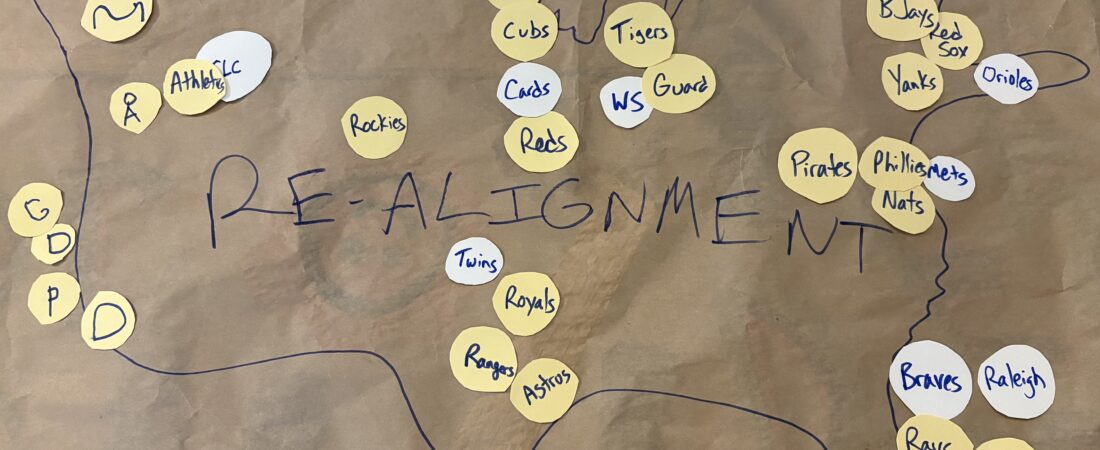
A famous political scientist, V.O. Key Jr., theorized that certain elections illustrate fundamental shifts in coalitions such that a new combination of issues and interests forms a new dominant majority. The broadly accepted examples are the 1860 abolition Republicans, the 1932 New Deal Democrats… and, I would argue, the 1980 Reagan-Christian-Right Republicans. These are basically generational kinds of elections. If the pattern holds we’ll be looking for a critical realignment to happen again soon. And indeed it shall… at least for baseball!
When MLB increases from 30 to 32 teams it will need to reorganize from 3 AL and 3 NL divisions with 5 teams each, to 4 and 4 with 4. Realignment happened before in 1969, 1994, and a little bit in 2013. I wish this lined up with V.O. Key’s theoretical years more closely, but I’m sure I could write a nice paper aligning alignments (see what I did there?). Anyway, we have some precedents and some criteria for how the new divisions will be formed. There are several forces and coalitions at work.
Geographical location was an important criteria mostly for travel cost. I’d argue that just doesn’t matter anymore. We have teams playing so many interleague games all over the country that travel cost simply won’t matter this time around. Geography matters when it comes to natural rivalries though. Beyond tradition and culture, rivalries bring in more dependable revenue. But even here, geography isn’t really the fight, it’s about which divisions have to give up which rivalries. In 1969, the biggest fight was about keeping Atlanta and Cincinnati in the west and Chicago and St. Louis in the east. Obviously that wasn’t about the geography, it was more about television markets. Simple-majority vote among owners decided the issue.
Maybe I’ve buried the lede (lead? led? Definitely bury led right, or does that contaminate the water supply?)… the whole thing is a negotiation between current owners. The new, prospective owners matter, but less so. They get thrown some bones to deal with potential annoyances. In 2013, the Astros were sold to Jim Crane, but as a condition of the sale Houston had to move divisions. The deal was brokered by the commissioner’s office with some financial benefits for the new ownership group, but the leverage is solidly with existing owners. This time ⅔ majority was needed for the vote. Tangent City- simple majorities seem to decide less and less in our contemporary world.
So we have the current owners, the two new potential ownership groups, and the MLB trying to negotiate the outcome. Is it possible that alignment affects the decision of which city gets an expansion franchise? Absolutely! The current commissioner has already made comments to the effect of “one in the east and one in the west.” Why would this matter? Honestly, in my opinion, I could see Nashville and Raleigh being the most fun duo for expansion. Something about geographic balance or perceived balance will factor into the decision. This is why I’m penciling in Salt Lake as the ‘other’ expansion franchise.
The foregoing paragraphs are the ‘real’ part of this post. Realignment is a crucial piece of the expansion discussion. Now, let’s do the fun stuff. Let’s try to work out what new divisions should look like. First off, we can’t ignore rivalries, but we kinda-should ignore geography otherwise. MLB teams play all over the place. I used to know the Cardinals’ roster backwards and forwards, but the Cubs just don’t play their rivals as much as they used to. That’s true for all teams.
Rivalries should be preserved as much as possible, but what about AL and NL? Those used to be two distinct leagues. One had a designated hitter, the other didn’t. That difference created ripples through roster construction, bench balance, and in-game management. Both leagues have a designated hitter now, so… is it worth preserving the artificial two-league thing? It’s an interesting place to pause and consider a couple other leagues. NBA just does East and West, but NFL still has NFC and AFC. In the end, I assume that baseball will not abandon the AL/NL split. That seems like a safe assumption based on tradition if nothing else.
So what should new divisions look like? I’ve moved things around quite a bit and no matter what, something keeps happening- compass directions don’t really fit. Sometimes it makes more sense for a “midwest” division, or a “great lakes” division. It just kind of reinforces the points above about the role of geography. I’ll offer up a few scenarios with different guiding principles. Nothing is perfect, but find your favorite.
Keeping NL and AL with new NL South and new AL North:
NL East: Mets Phillies Pirates Reds
NL Central: Cubs Cardinals Brewers Rockies
NL West: Dodgers Padres Giants Diamondbacks
NL South: Nationals Raleighs Braves Marlins
AL East: RedSox Yankees Orioles Rays
AL Central: Rangers Astros Royals Twins
AL West: Angels Athletics Mariners SaltLakeCitys
AL North: BlueJays WhiteSox Guardians Tigers
Preserve rivalries:
NL East: Braves Mets Phillies Nationals
NL Central: Cubs Cardinals Brewers Reds
NL West: Dodgers Padres Giants Diamondbacks
NL South: Raleighs Marlins Rays Pirates
AL East: RedSox Yankees BlueJays Orioles
AL Central: WhiteSox Guardians Royals Tigers
AL West: Angels Athletics Mariners Astros
AL (idk) : Twins Rangers SaltLakeCitys Rockies
Feels Right To Me:
NL East: Phillies Nationals Pirates Mets
NL South: Braves Raleigh Rays Marlins
NL Central: Cubs Twins Brewers Cardinals
NL West: Dodgers Diamondbacks Padres Giants
AL East: RedSox Yankees BlueJays Orioles
AL Midwest : WhiteSox Guardians Tigers Reds
AL Central: Royals, Rangers, Astros, Rockies
AL West: Mariners Athletics Angels SaltLakeCitys

Leave a Reply